Wednesday, February 18, 2015

Flibbertigibbet, Batrachomyomachy, and Finifugal

Take a guess why I chose these three words for this week.
You're wrong.
I chose Flibbertigibbet, Batrachomyomachy, and Finifugal because they are specifically words that you will never remember how to say. Even when writing this post, I could never say the first two the same way twice. So have fun.

Flibbertigibbet: Flibber-te-GIB-bit
Depending on whether you understand this word to be a noun or an adjective, it could mean exactly what it says. You could even go as far to say that it's onomatopoetic. As an adjective, Flibbertigibbet means "balderdash" or "nonsense." How convenient.
On the other hand, Flibbertigibbet can also be a noun, meaning "Someone that is a talkative chatterbox." It's usually in reference to a woman, but really anyone can be a Flibbertigibbet. Heck, sometimes I can be a Flibbertigibbet.
This word likely is just a nonsense phrase from the 1400s, much like yakkity-yak or yadda-yadda-yadda. Fuzzy-Wuzzy. Handy-Dandy. Jibber-Jabber. Those are called Rhyming Compounds. 

Batrachomyomachy (n.): But-rock-uh-my-AH-muh-kee
Face the facts. You'll never be able to pronounce this. I've tried so many times and a couple minutes later, I have to try again.
Don't worry. Phineas and Ferb know
what you're talking about.
As long as we're talking about words about themselves and onomatopoetic, we come to Batrachomyomachy. How many times did you want to tell someone that they were over-exaggerating something that is completely pointless, but you didn't want to use the hackneyed phrase "Making a mountain out of a molehill"? That's why you can just say "Stop being a Batrachomyomachist!"
Oddly enough, by saying Batrachomyomachy, you are making a mountain of a problem by trying to say a molehill of a phrase.
The word comes to us from Latin. Ah, those Romans, always coming up with weird phrases. So the Latin root Batracho- means "Frog", Mys- means "Mouse", and -Mochy means "Fight". So, really, by making a Mountain out of a Molehill, you're just making the frog and the mouse fight.
This is also the title of a short epic poem, translated to The Battle of Frog and Mice. You can read it here, but it's pretty self-explanatory as to what it's about.

Finifugal (adj.): Fini-FEW-gull
I find that this is actually one of the most interesting words I've found in a while, besides the other two in this post. Briefly, the word Finifugal is used to describe someone who doesn't like ending things, albeit relationships, books, blog posts, etc. I sometimes feel like I'm not very Finifugal, but then I rememb--

Wednesday, February 11, 2015

Lots of Words

Yay lots of words:


Yarborough:
The word Yarborough comes from the year 1897, when the Earl of Yarborough, Charles Worsley, bet a 1 in 1000 chance of getting a poker or bridge hand with no cards above a 9.

Purlicue:
Hold out your hand. Spread your fingers apart. Now look at that web of skin in between your thumb and index finger. That's your Purlicue. It rhymes with Curly Q. Supposedly, when you have a headache, doctors suggest that pinching your purlicue is helpful. Let me try that after I finish all my English homework..........

Jamais Vu
If you remember my post on Semantic Satiation, then you may already know the meaning behind Jamais Vu. While Semantic Satiation is saying a word so many times that it starts to sound weird, Jamais Vu is when you stare at a familiar word for a long time.
Take the word tongue:
 tongue              tongue              tongue              tongue              tongue              tongue              tongue              tongue              tongue              tongue              tongue              tongue              tongue              tongue              tongue              tongue              tongue              tongue              tongue              tongue              tongue              tongue              tongue              tongue              tongue              tongue              tongue              tongue              tongue              tongue              tongue              tongue              tongue              tongue              tongue              tongue              tongue              tongue              tongue              tongue              tongue              tongue              tongue              tongue              tongue              tongue              tongue              tongue              tongue              tongue              tongue              tongue              tongue              tongue

Doesn't it look weird now?
Of course it does.

Rheum:
You know when you wake up and you have those disgusting little "eye-crispies"? Yeah, those are officially called Rheum. I used to call those Sleepers, but people also call them Eye Rocks or just Sleeps.


Wednesday, February 4, 2015

1950's slang

So, as an avid reader of my blog, which I just know you are, you should remember my post on Victorian-Era slang. It was a great post- one of my favorites, actually. So I decided I want to do one again, because it was a lot of fun. Fun fact: Slang is actually a slang word. It's simply short for Shortened Language. It's a autonym. So here, have some 1950's slang.

I bet you're wondering, how does a flutter bum like me get to be so hep? Well, I'll clue you. Around round up time of 2013, I wasn't very cranked to go to the corral. I had a lot of moldies who gave me a crazy lot of mush. So I thought "Hey, this place is such a Nowheresville." So my reds and I, who were quite radioactive, all shucked, sluffed, and shot down. Now I'm just some fream, circled with a couple ankle-biters. It's a good thing that I lit up the tilt sign when I told you this.

Well, that didn't make much sense, now did it... Here, let me help:

I bet you're wondering, how does a handsome young man like me get to be so awesome ? Well, I'll tell you about it. Around the end of Summer Vacation of 2013, I wasn't very excited to go to the schoolyard. I had a lot of bad teachers who gave me a buttload of homework. So I thought "Hey, this place is such a Lame place to be." So my Communists and I, who were quite popular, all lied, cheated, skipped classes, and failed. Now I'm just some guy that doesn't fit in, married with a couple children. It's a good thing that I made this all up when I told you this.

Wait, but there's more, okay? Just some great phrases that we should bring back:
Apple-Butter - someone who is a smooth-talker
Clyde: A regular guy
Sophie: Another boy's girlfriend
What's Buzzin', cuzzin?: What's new? / What's up?
What's your tale, Nightingale?  What's your story? What's the matter?
Come on, Snake! Let's Rattle!  May I dance with you, miss?
and, my favorite: Another way to say Make like a tree and Leave:
Put an egg in your shoe and beat it!

One thing that I've noticed from this reading is that we still use so many of their slang, even on a regular basis. I mean, Dr. Seuss coined the word nerd in the 50's, and I call people nerds all day, every day. Spaz, a tight group of friends. punks, "No sweat!", even to Make Out-- all of these phrases come from the 1950's!

Anyway, if you disregard the war, the blatant sexism, the blatant racism, the discrimination, Jim Crow laws still in effect, Polio, Domestic Violence, Joe McCarthy, Civil Rights-- Ah, hell. It was all pretty bad. EXCEPT FOR THE SLANG. THAT WAS REALLY COOL!

Tuesday, January 27, 2015

Qualtaghs, Velleities

Hey, you reading this. Happy New Year. (Not you, China. You'll have your chance.)
Oh, well, I guess I'm about 27 days too late for that...

Isn't it only appropriate, then, that the words relate to the New Year? Yes, I think so too.

Qualtaghs-
Justin- A rare breed of hippo
Kevin- A measurement of time equivalent to how long it takes Jessie to fill her daily selfie quote
Jessie- Elephants with Cholera
Mom- A number of cattle in a newly started herd
Dad- The best fly for catching Argentinean Brown in a river
Kimmy- The Achievement of ultimate understanding of all things blue.

Some words just seem so obscure, and their definition so random, which I thought immediately about this word. Then I researched it a bit and found the true story behind it.
Qualtagh refers to the first person you meet after the New Year.
Qualtagh comes from a dialect of Gaelic known as Manx, spoken on the Isle of Man. (Pictured) The Manx language is slowly dying, despite many attempts to revive it. It is very well-documented, so we'll never fully lose it.

Why, you ask, is there possibly a word for that? Well, let me tell you a little story:
The word Qualtagh literally means, in Manx, "First Foot". It is a popular superstition that if your Qualtagh is a dark-haired man, you will have good luck for the year. Alternatively, if your Qualtagh was a female, too bad. Not-So-Good luck for you. And a red-head? The worst of luck will be upon you. Sorry.
Not only are Qualtaghs people that you meet right after the New Year, but also people that women meet immediately after leaving home after being stuck taking care of a newborn.
All of the BeeGee's were/are Manx people. Fun fact.

Velleities:
Justin- A restaurant for Jedi's
Kevin- The feeling of helplessness against overwhelming stupidity
Jessie- A leaf shaped like a foot
Mom- The unions that support Parking Valets
Dad- The bugs in software when programmers don't have enough coffee
Kimmy- The hairs on the legs of insects.

Alright. We're all guilty of it. We start on a New Year's Resolution, only to never actually make any progress on it. You know, the whole "Oh, I'm going to start going to the gym this year. I'll research gyms right now." And then, you proceed to use all your time on the internet liking pictures of cats on Facebook.
That's a Velleity.  Here, I'll make a chart for you, most productive to least productive:

◄--(Starting immediately)---------------------(Procrastination)-----------------------------------------(Velleities)---►

Marketer Matt Bailey described a Velleity as such: "A desire to see something done, but not enough desire to do something about it."
Surprisingly, Velleity comes from the same word as its opposite, Volition. Both of these words come from the Latin verb velle, meaning to wish. Volition, though, comes directly from the "Me" conjugation, Volo.  Benevolent also comes from the same word, meaning "well-wishing"

Tuesday, December 16, 2014

Impecunious, Hoarfrost

*sigh* It's that time of year, isn't it... The time where you walk outside to the brisk air, only to slip on ice. The time of shaking all the hoarfrost off the plants in your garden. The time of gift giving, but more importantly (and expensively), gift buying. You watch your wallet slowly cripple with hunger, but to no avail. It moans for more cash, but, shame, you spent all your money on presents, you poor, impecunious being.

Hoarfrost:
Mom: Ice that forms instantaneously on muddy ground
Dad:
Kevin: Frost that only occurs on trees
Justin: Frost that only occurs on a horse

Okay. Close your eyes. Now imagine frost on the ground. Imagine frost on the window. Imagine Frosty the Snowman. Imagine Frosty in a bikini. Now open your eyes. I'm on a centaur.  This blog is brought to you by Old Spice.
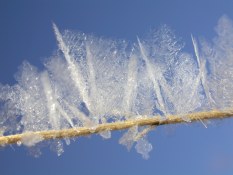
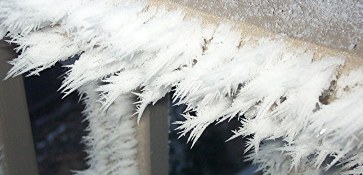
Anyway, back to frost. Don't you always feel so bad for your plants that are all outside in the snow, and they're always covered in that really cool frost? That frost is known as Hoarfrost (left), and it's a less common version of "regular" frost. What's so special about Hoarfrost is that it comes about by water in the air freezing to the currently-frozen plant. When the wind blows the moisturized air into the ice, some of that water in the air gets frozen to the plant and it builds and it builds and it builds and it builds. When freezing temperatures converge with fog, however, the result is a phenomenon called "Rime Formations" (below)

The word Hoarfrost, though it has no clear etymology, appears in the Bible. 
"He giveth snow like wool; he spreadeth the hoarfrost like ashes" -KJV Psalm 147:16.


Impecunious:
Mom: Having no taste, tasteless
Dad:
Kevin: Utterly forgettable
Justin: Disturbing

Don't you hate talking to your friends (or strangers at the bus stop) and then have to explain that you have no money, but you don't want to say the word "broke"? Well now, for the low low price of $19.99, you can use the word Impecunious to avoid saying that your pockets are hole-y. Because they are synonyms after all.
The word Impecunious comes to us from none other than the Latin-speakers. Yes, the Romans and their many words... They obviously didn't want Jesus, Alexander the Great, and Cleopatra knowing their weakness of no-money syndrome, so they made this word that others wouldn't understand.*
Anyway, the Latin word pecunious means money, and that combined with im-, meaning not, you now have the word that is synonymous with Not Money. Language!

*That's all a lie. None of those lived in the same time period. I'm funny.

Tuesday, December 9, 2014

Assonance, Zeugmas, and Paraprosdokians

Recently, while surfing the web, I came across some words regarding language (Assonance, Zeugmas, and Paraprosdokians), and how it may be portrayed in poetry, metaphors, and humor, respectively. These aren't words that you can use in daily conversation, but may just be good words to know.

So what is Assonance? Assonance is a form of poetry where the same sound is repeated over and over. This could be a set of vowels, a set of consonants, or a combination of both.
In English, there are two common lines involving Assonance:
How now, Brown Cow?  and  The Rain in Spain falls Mainly on the Plain
Assonance is simply alliteration of sounds and syllables instead of specific letters.
A more "severe" form of this poetry is Univocalic Style. Guess why.          No, go ahead. Guess. I bet you're wrong.
Univocalic Poetry is when the author uses only one vowel, (A, E, I, O, or U) and no other. I can see that being really difficult. Here, let me try:
Gordon cooks food:
Wow, good food.
Josh cooks food:
Poor food.
I guess it wasn't as difficult as I thought... But Reverse Univocalic. That's really difficult, like this classic example:

How quickly can you find out what is so unusual about this paragraph? It looks so ordinary that you would think that nothing is wrong with it at all, and, in fact, nothing is. But it is unusual. Why? If you study it and think about it, you may find out, but I am not going to assist you in any way. You must do it without coaching. No doubt, if you work at it for long, it will dawn on you. Who knows? Go to work and try your skill. Par is about half an hour.


That paragraph contained no E's. How does one even do that?
*********************************************************************************
Zeugmas are a pretty cool figure of speech where you combine a metaphoric reference with a literal one, and tie it all together. For example, with weeping eyes and hearts, or You are free to execute your laws, and your citizens, as see fit.*
While researching this, I found my favorite one in the comments section of an article:
"Hitmen are expensive, so she took out a loan and her husband."
Also, there's basically no information on this, so let's move on, shall we?

*That one was from a Star Trek episode. Fun Fact.
*********************************************************************************
Paraprosdokians, otherwise known as the most annoying word to spell, are actually a really fun figure of wordplay. It's been used multiple times by well-known names, such as Stephen Colbert, Winston Churchill, Groucho Marx, Aristotle, and, of course, Homer Simpson.
So what is a Paraprosdokian? Well, if you figure that Para- means Against, and Prosdokia- means Expectation, you can assume that it means Something Unexpected. And that's exactly what it is. A Paraprosdokian is a phrase with an unexpected turn at the end, normally humorous. For instance:
"You can always count on Americans to do the right thing--After trying everything else first." -Winston Churchill

Now, what's interesting is that every so often, you get a Paraprosdokian that plays on a word and a different meaning on that same word, like: Time flies like an arrow, while fruit flies like a banana. This is playing off the word "Fly", using it as both a verb and a noun. Does that sound familiar at all? I should hope so, because this Paraprosdokian is actually a form of a Zeugma! Yes! That word you just learned! Except that these also go by another name: Garden Path Sentences:

Garden Path Sentences are forms of Zugmas and Paraprosdokians, but a bit more complex. For example, try to make sense of the following sentence.
The old man the boat.
It's a bit confusing, right? But if you think about it, and after you splice the sentence (make it more clear), you end up with something along the lines of "The boat was manned by the Elderly"
The name "Garden Path Sentences" comes from the saying "To be led down the garden path", rather, "To mislead"

Wednesday, December 3, 2014

Wintercearig

What a great word, Wintercearig. (Win-ter-sherry)  I'm sure that you can guess what this adjective means, but can other people?
Mom: A Gaelic word. A jaunty, frolicky manner
Dad: Dark and Gloomy
Kevin: Having snowman-like features
Justin: Dressed with respect to the season
Jessie: Someone who goes down chimneys. (I think she didn't want to create an adjective.)
Kimmy: Disappointing, in reference to when it rains (as opposed to snowing)

Oh, what sorrow for Wintercearig people. It's sad, don't you think, when someone is brought down in the dumps by a Christmas-y, snowy Winter...
Then again, I am very Wintercearig when it snows and, I mean, you have to go out in the snow, right? But then you come back in and you sit your bones down by the fire, but you're still cold on the inside... And that kinda sucks. You know what else puts me in a Wintercearig mood? The greediness that lies within all people during the Christmas shopping season. 

Anyway, Wintercearig.
This word comes to us with many thanks to Alemania, rather, Germany. I mean, I'm guessing you can figure out what Winter means... But the Cearig? Where does that come from? Well, it actually derives from the Proto-Germanic* root Karagaz, which means Anxious or Wary. What's more, the English word Chary, which also means Wary.

So yeah. Wintercearig.

*The most "recent" version of the language

Pro-Tip: Compliment/Thank all your cashiers whenever you go shopping because they probably had a really rough day!!!